Synthetic Spin Chemistry
We use molecular synthesis to control how electron spins evolve and how that evolution shapes chemical reactions and light emission. Our research develops Synthetic Spin Chemistry: a physical-organic approach that connects molecular structure to spin, charge, and excited-state dynamics. Light can prepare molecules in states far from thermal equilibrium. What happens next depends on their structure: where charges reside, how spins interact, and which reaction pathways become accessible. By systematically changing molecular architecture and measuring the resulting dynamics, we seek to establish chemical design principles for controlling these processes. Our goal is to turn that control into new molecular functions, from magnetically responsive emission to photochemical reactivity. We combine molecular synthesis with physical chemistry methods, including ultrafast and time-resolved optical spectroscopy, EPR, and magnetic-field-dependent emission measurements, to determine how molecular structure governs charge-transfer kinetics, spin interactions, and emission.
Active Projects
Spin-Correlated Radical Pairs and the Associated Emissions for Quantum Information Science
Photoinduced electron transfer can create two radicals whose electron spins retain a correlation inherited from the precursor excited state. These spin-correlated radical pairs (SCRPs) provide a platform for investigating how molecular structure controls the preparation, evolution, and reaction of coupled spins (Chemical Physics Review 2022).
We design donor–bridge–acceptor molecules in which the bridge, connectivity, and electronic properties tune the interactions between the radicals and their competing reaction pathways. This approach allows us to investigate how structural changes influence charge separation, spin evolution, and charge recombination. A central focus is making these dynamics observable through light. We have developed molecular systems that exhibit long-range charge-transfer emission (JPC Letters, 2019) and delayed fluorescence (JACS, 2020) following charge recombination. Because recombination depends on the radical pair’s spin state, magnetic fields can change the emission. Molecular design therefore provides a route to adjusting both the optical signal and its magnetic response.
We are extending this framework to control the magnitude and field dependence of emission responses (e.g., JACS, 2025) , couple radical-pair dynamics to photon upconversion, and explore molecular approaches to quantum sensing. These studies connect the chemistry of individual molecules to the behavior of nonequilibrium spin systems.
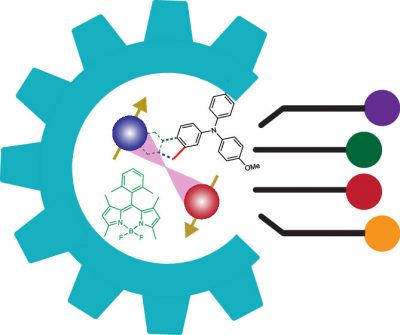
Heavy-Atom-Free Photoredox Catalysis using Singlet and Triplet Excited States of Organic Molecules
Triplet excited states are important electronic states, but those of organic molecules are underutilized. We explore ways to efficiently produce triplet excited states of organic molecules without heavy atoms such as precious metals, and utilize them in various applications including organic synthesis, molecular electronics, and energy technologies.
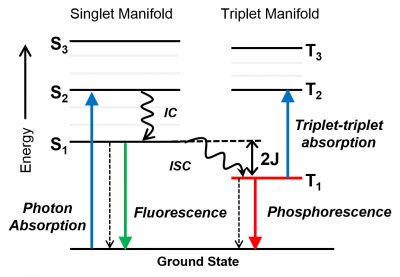 One of the mechanisms we are actively pursuing is spin-orbit, charge-transfer intersystem crossing (SOCT-ISC). SOCT-ISC is one of the promising mechanisms that can produce triplet excited states of organic molecules without using heavy-atom effects. We have recently uncovered the energetic requirements for this mechanism, establishing one of the general design criteria for donor-acceptor molecules that can produce triplet excited states efficiently (Chem, 2019). We used this new class of molecules in triplet-triplet upconversion under aerobic conditions using a unique soft mater system (ACS AMI, 2020) as well as a photocatalyst in organic synthesis (ACS Omega, 2021).
Connecting Structure to Dynamics
Our work combines molecular design and synthesis with time-resolved spectroscopy, magnetic-field measurements, EPR, and computational chemistry. These complementary tools allow us to connect molecular structure to processes occurring across different timescales.
We also employ vibrational spectroscopy to unravel the nature of charges and CS states. In particular, we take advantage of and push the limits of the sensitivity of nitrile (CN) vibrations. We have shown that the nitrile vibration acts as an excellent vibrational probe for radical anions. They are sensitive to the induced electric field and the delocalization of electrons (JACS 2015#1, JACS 2015 #2, JPC-B 2016). Our recent works show that we can gain unique insights into the energy and dynamics of free charges (JPC-B 2017 , JPC-B 2020) as well as those of CS states (JPC-A 2018). We showed that the IR linewidth and intensities, in addition to the frequency shifts, can provide complimentary and unique information (Chem Sci 2021).